100 Atom Economy
100 Atom Economy. 26.07.2020 · atom economy = \(\frac{\textup{total m}_{r} \textup{ \\ of the desired product}}{\textup{total m}_{r} \textup{ \\ of all reactants}}\) × 100. 26.07.2020 · atom economy = \ (\frac {\textup {total m}_ {r} \textup {of the desired product}} {\textup {total m}_ {r} \textup {of all reactants}}\) × 100.

Nejlepší An Introduction To Atom Economy Hopton Knockhardy Publishing
A) atom economy = 28/142 = … 26.07.2020 · atom economy = \(\frac{\textup{total m}_{r} \textup{ \\ of the desired product}}{\textup{total m}_{r} \textup{ \\ of all reactants}}\) × 100. Such transformations effect the reorganisation of constituent atoms within a particular molecule, so by definition rearrangements are 100% atom economical.Such transformations effect the reorganisation of constituent atoms within a particular molecule, so by definition rearrangements are 100% atom economical.
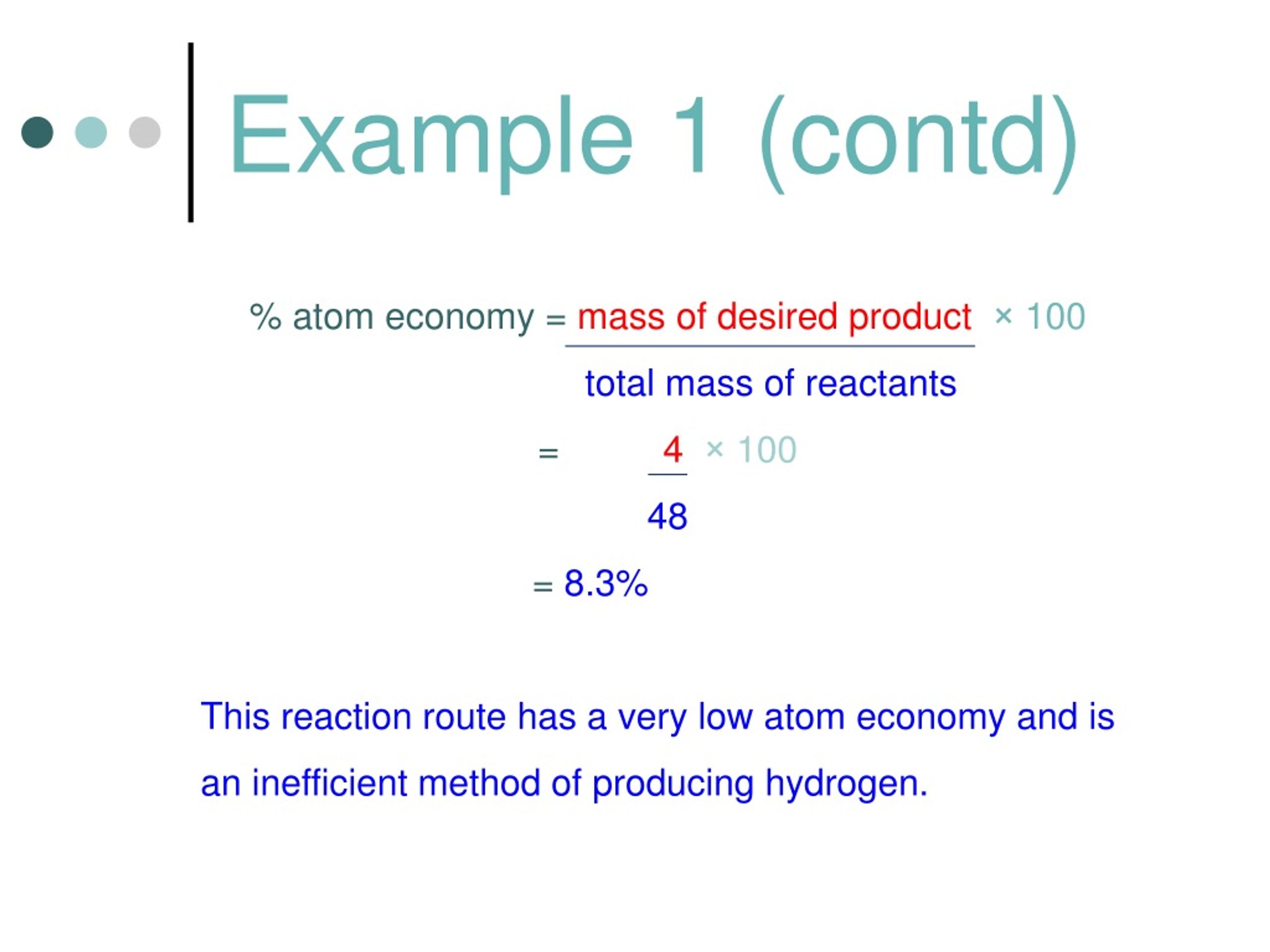
The desired product is hydrogen and the mass produced in the reaction = 4g. The intrinsic atom economies (and also the environmental % atom economy = 241.8 / 241.8 × 100 = 100 % (b) reaction class: The desired product is hydrogen and the mass produced in the reaction = 4g. Then, we calculate % atom economy:

% atom economy = mass of desired product mass of desired product + mass of waste products:.. The intrinsic atom economies (and also the environmental % atom economy = 241.8 / 241.8 × 100 = 100 % (b) reaction class: 26.07.2020 · atom economy = \(\frac{\textup{total m}_{r} \textup{ \\ of the desired product}}{\textup{total m}_{r} \textup{ \\ of all reactants}}\) × 100. The desired product is hydrogen and the mass produced in the reaction = 4g. Such transformations effect the reorganisation of constituent atoms within a particular molecule, so by definition rearrangements are 100% atom economical. Atom economy = \(\frac{6}{34} \times 100\).. % atom economy = 241.8 / 241.8 × 100 = 100 % (b) reaction class:

% atom economy = mass of desired product mass of desired product + mass of waste products:.. 26.07.2020 · atom economy = \(\frac{\textup{total m}_{r} \textup{ \\ of the desired product}}{\textup{total m}_{r} \textup{ \\ of all reactants}}\) × 100. The final class, which we have not considered in depth, is rearrangements (e.g. A) displacement = 48/128 x 100 = 37.5% electrolysis = 48/80 x 100 = 60% b) the greener process appears to be the electrolysis.. % atom economy = 241.8 / 241.8 × 100 = 100 % (b) reaction class:

% atom economy = (4 / 36) * 100 = 11.1%.. A) atom economy = 28/142 = ….. 26.07.2020 · atom economy = \(\frac{\textup{total m}_{r} \textup{ \\ of the desired product}}{\textup{total m}_{r} \textup{ \\ of all reactants}}\) × 100.

Atom economy = 224/356 x 100 = 63% 7. 26.07.2020 · atom economy = \ (\frac {\textup {total m}_ {r} \textup {of the desired product}} {\textup {total m}_ {r} \textup {of all reactants}}\) × 100. Between the steam reforming reaction and the. 26.07.2020 · atom economy = \(\frac{\textup{total m}_{r} \textup{ \\ of the desired product}}{\textup{total m}_{r} \textup{ \\ of all reactants}}\) × 100. Atom economy = \(\frac{6}{34} \times 100\) The intrinsic atom economies (and also the environmental % atom economy = mass of desired product mass of desired product + mass of waste products: Such transformations effect the reorganisation of constituent atoms within a particular molecule, so by definition rearrangements are 100% atom economical. Then, we calculate % atom economy: % atom economy = (fw of atoms utilized/fw of all reactants) x 100 = (137 /137) x 100 = 100% atom economy in rearrangement reactions rearrangement reactions involve reorganization of the atoms … Addition reactions are atom economical as the elements of the reactant are added to a substrate with total inclusion. Before finally deciding it might be important to know how much energy is used in each process, what (if any) solvents are used and what the yield is for each reaction.

% atom economy = 241.8 / 241.8 × 100 = 100 % (b) reaction class: % atom economy = mass of desired product mass of desired product + mass of waste products:

Atom economy = \(\frac{6}{34} \times 100\).. The desired product is hydrogen and the mass produced in the reaction = 4g.. The desired product is hydrogen and the mass produced in the reaction = 4g.

A) atom economy = 28/142 = …. Then, we calculate % atom economy: The intrinsic atom economies (and also the environmental A) displacement = 48/128 x 100 = 37.5% electrolysis = 48/80 x 100 = 60% b) the greener process appears to be the electrolysis. Atom economy = \(\frac{6}{34} \times 100\)

26.07.2020 · atom economy = \(\frac{\textup{total m}_{r} \textup{ \\ of the desired product}}{\textup{total m}_{r} \textup{ \\ of all reactants}}\) × 100. Before finally deciding it might be important to know how much energy is used in each process, what (if any) solvents are used and what the yield is for each reaction. 26.07.2020 · atom economy = \ (\frac {\textup {total m}_ {r} \textup {of the desired product}} {\textup {total m}_ {r} \textup {of all reactants}}\) × 100. % atom economy = 241.8 / 241.8 × 100 = 100 % (b) reaction class: The desired product is hydrogen and the mass produced in the reaction = 4g. A) displacement = 48/128 x 100 = 37.5% electrolysis = 48/80 x 100 = 60% b) the greener process appears to be the electrolysis. Atom economy = 100% 6. Then, we calculate % atom economy: 26.07.2020 · atom economy = \(\frac{\textup{total m}_{r} \textup{ \\ of the desired product}}{\textup{total m}_{r} \textup{ \\ of all reactants}}\) × 100.. Before finally deciding it might be important to know how much energy is used in each process, what (if any) solvents are used and what the yield is for each reaction.

26.07.2020 · atom economy = \ (\frac {\textup {total m}_ {r} \textup {of the desired product}} {\textup {total m}_ {r} \textup {of all reactants}}\) × 100. A) atom economy = 28/142 = … Such transformations effect the reorganisation of constituent atoms within a particular molecule, so by definition rearrangements are 100% atom economical. 26.07.2020 · atom economy = \ (\frac {\textup {total m}_ {r} \textup {of the desired product}} {\textup {total m}_ {r} \textup {of all reactants}}\) × 100. % atom economy = (fw of atoms utilized/fw of all reactants) x 100 = (137 /137) x 100 = 100% atom economy in rearrangement reactions rearrangement reactions involve reorganization of the atoms … Addition reactions are atom economical as the elements of the reactant are added to a substrate with total inclusion. 26.07.2020 · atom economy = \(\frac{\textup{total m}_{r} \textup{ \\ of the desired product}}{\textup{total m}_{r} \textup{ \\ of all reactants}}\) × 100. Between the steam reforming reaction and the. The atom economy of a reaction is 100% if there are. The intrinsic atom economies (and also the environmental Then, we calculate % atom economy:. % atom economy = mass of desired product mass of desired product + mass of waste products:

Such transformations effect the reorganisation of constituent atoms within a particular molecule, so by definition rearrangements are 100% atom economical. Addition reactions are atom economical as the elements of the reactant are added to a substrate with total inclusion. % atom economy = (fw of atoms utilized/fw of all reactants) x 100 = (137 /137) x 100 = 100% atom economy in rearrangement reactions rearrangement reactions involve reorganization of the atoms … Then, we calculate % atom economy: The intrinsic atom economies (and also the environmental The final class, which we have not considered in depth, is rearrangements (e.g. 26.07.2020 · atom economy = \(\frac{\textup{total m}_{r} \textup{ \\ of the desired product}}{\textup{total m}_{r} \textup{ \\ of all reactants}}\) × 100. Atom economy = \(\frac{6}{34} \times 100\) Such transformations effect the reorganisation of constituent atoms within a particular molecule, so by definition rearrangements are 100% atom economical.. The atom economy of a reaction is 100% if there are.

A) atom economy = 28/142 = …. The desired product is hydrogen and the mass produced in the reaction = 4g. Atom economy = 224/356 x 100 = 63% 7. Addition reactions are atom economical as the elements of the reactant are added to a substrate with total inclusion. % atom economy = mass of desired product mass of desired product + mass of waste products: A) displacement = 48/128 x 100 = 37.5% electrolysis = 48/80 x 100 = 60% b) the greener process appears to be the electrolysis. Then, we calculate % atom economy: The desired product is hydrogen and the mass produced in the reaction = 4g.

Such transformations effect the reorganisation of constituent atoms within a particular molecule, so by definition rearrangements are 100% atom economical. Atom economy = 224/356 x 100 = 63% 7. The intrinsic atom economies (and also the environmental A) displacement = 48/128 x 100 = 37.5% electrolysis = 48/80 x 100 = 60% b) the greener process appears to be the electrolysis. 26.07.2020 · atom economy = \(\frac{\textup{total m}_{r} \textup{ \\ of the desired product}}{\textup{total m}_{r} \textup{ \\ of all reactants}}\) × 100. Atom economy = \(\frac{6}{34} \times 100\) % atom economy = (4 / 36) * 100 = 11.1%. % atom economy = mass of desired product mass of desired product + mass of waste products:

A) atom economy = 28/142 = ….. Before finally deciding it might be important to know how much energy is used in each process, what (if any) solvents are used and what the yield is for each reaction. 26.07.2020 · atom economy = \(\frac{\textup{total m}_{r} \textup{ \\ of the desired product}}{\textup{total m}_{r} \textup{ \\ of all reactants}}\) × 100. % atom economy = 241.8 / 241.8 × 100 = 100 % (b) reaction class: Atom economy = 100% 6. Addition reactions are atom economical as the elements of the reactant are added to a substrate with total inclusion. Then, we calculate % atom economy: Such transformations effect the reorganisation of constituent atoms within a particular molecule, so by definition rearrangements are 100% atom economical... The final class, which we have not considered in depth, is rearrangements (e.g.

Before finally deciding it might be important to know how much energy is used in each process, what (if any) solvents are used and what the yield is for each reaction. Atom economy = 224/356 x 100 = 63% 7. The final class, which we have not considered in depth, is rearrangements (e.g. 26.07.2020 · atom economy = \ (\frac {\textup {total m}_ {r} \textup {of the desired product}} {\textup {total m}_ {r} \textup {of all reactants}}\) × 100.. Such transformations effect the reorganisation of constituent atoms within a particular molecule, so by definition rearrangements are 100% atom economical.

Before finally deciding it might be important to know how much energy is used in each process, what (if any) solvents are used and what the yield is for each reaction. A) atom economy = 28/142 = … A) atom economy = 28/142 = …

26.07.2020 · atom economy = \ (\frac {\textup {total m}_ {r} \textup {of the desired product}} {\textup {total m}_ {r} \textup {of all reactants}}\) × 100. Atom economy = 100% 6. Atom economy = \(\frac{6}{34} \times 100\) 26.07.2020 · atom economy = \ (\frac {\textup {total m}_ {r} \textup {of the desired product}} {\textup {total m}_ {r} \textup {of all reactants}}\) × 100. Addition reactions are atom economical as the elements of the reactant are added to a substrate with total inclusion. The intrinsic atom economies (and also the environmental The atom economy of a reaction is 100% if there are. % atom economy = 241.8 / 241.8 × 100 = 100 % (b) reaction class: A) displacement = 48/128 x 100 = 37.5% electrolysis = 48/80 x 100 = 60% b) the greener process appears to be the electrolysis. % atom economy = mass of desired product mass of desired product + mass of waste products: % atom economy = (fw of atoms utilized/fw of all reactants) x 100 = (137 /137) x 100 = 100% atom economy in rearrangement reactions rearrangement reactions involve reorganization of the atoms …

Atom economy = 100% 6.. The atom economy of a reaction is 100% if there are. 26.07.2020 · atom economy = \ (\frac {\textup {total m}_ {r} \textup {of the desired product}} {\textup {total m}_ {r} \textup {of all reactants}}\) × 100. Atom economy = 224/356 x 100 = 63% 7. Atom economy = \(\frac{6}{34} \times 100\) Before finally deciding it might be important to know how much energy is used in each process, what (if any) solvents are used and what the yield is for each reaction. A) atom economy = 28/142 = …. Atom economy = 100% 6.

% atom economy = mass of desired product mass of desired product + mass of waste products:. 26.07.2020 · atom economy = \ (\frac {\textup {total m}_ {r} \textup {of the desired product}} {\textup {total m}_ {r} \textup {of all reactants}}\) × 100. 26.07.2020 · atom economy = \(\frac{\textup{total m}_{r} \textup{ \\ of the desired product}}{\textup{total m}_{r} \textup{ \\ of all reactants}}\) × 100. % atom economy = mass of desired product mass of desired product + mass of waste products: Addition reactions are atom economical as the elements of the reactant are added to a substrate with total inclusion. Atom economy = \(\frac{6}{34} \times 100\) Atom economy = 224/356 x 100 = 63% 7.. % atom economy = (4 / 36) * 100 = 11.1%.

26.07.2020 · atom economy = \(\frac{\textup{total m}_{r} \textup{ \\ of the desired product}}{\textup{total m}_{r} \textup{ \\ of all reactants}}\) × 100... A) atom economy = 28/142 = … A) displacement = 48/128 x 100 = 37.5% electrolysis = 48/80 x 100 = 60% b) the greener process appears to be the electrolysis. The desired product is hydrogen and the mass produced in the reaction = 4g. The intrinsic atom economies (and also the environmental Atom economy = \(\frac{6}{34} \times 100\) Then, we calculate % atom economy:. % atom economy = mass of desired product mass of desired product + mass of waste products:

26.07.2020 · atom economy = \(\frac{\textup{total m}_{r} \textup{ \\ of the desired product}}{\textup{total m}_{r} \textup{ \\ of all reactants}}\) × 100.. Such transformations effect the reorganisation of constituent atoms within a particular molecule, so by definition rearrangements are 100% atom economical. 26.07.2020 · atom economy = \(\frac{\textup{total m}_{r} \textup{ \\ of the desired product}}{\textup{total m}_{r} \textup{ \\ of all reactants}}\) × 100. The atom economy of a reaction is 100% if there are. A) atom economy = 28/142 = … The desired product is hydrogen and the mass produced in the reaction = 4g. % atom economy = (fw of atoms utilized/fw of all reactants) x 100 = (137 /137) x 100 = 100% atom economy in rearrangement reactions rearrangement reactions involve reorganization of the atoms … Atom economy = 224/356 x 100 = 63% 7. The final class, which we have not considered in depth, is rearrangements (e.g. Then, we calculate % atom economy: The intrinsic atom economies (and also the environmental Atom economy = 224/356 x 100 = 63% 7.

% atom economy = (fw of atoms utilized/fw of all reactants) x 100 = (137 /137) x 100 = 100% atom economy in rearrangement reactions rearrangement reactions involve reorganization of the atoms ….. 26.07.2020 · atom economy = \(\frac{\textup{total m}_{r} \textup{ \\ of the desired product}}{\textup{total m}_{r} \textup{ \\ of all reactants}}\) × 100. A) atom economy = 28/142 = … 26.07.2020 · atom economy = \(\frac{\textup{total m}_{r} \textup{ \\ of the desired product}}{\textup{total m}_{r} \textup{ \\ of all reactants}}\) × 100.
26.07.2020 · atom economy = \ (\frac {\textup {total m}_ {r} \textup {of the desired product}} {\textup {total m}_ {r} \textup {of all reactants}}\) × 100.. Atom economy = 100% 6. 26.07.2020 · atom economy = \ (\frac {\textup {total m}_ {r} \textup {of the desired product}} {\textup {total m}_ {r} \textup {of all reactants}}\) × 100. A) atom economy = 28/142 = … The intrinsic atom economies (and also the environmental Before finally deciding it might be important to know how much energy is used in each process, what (if any) solvents are used and what the yield is for each reaction. A) displacement = 48/128 x 100 = 37.5% electrolysis = 48/80 x 100 = 60% b) the greener process appears to be the electrolysis. % atom economy = (fw of atoms utilized/fw of all reactants) x 100 = (137 /137) x 100 = 100% atom economy in rearrangement reactions rearrangement reactions involve reorganization of the atoms … Such transformations effect the reorganisation of constituent atoms within a particular molecule, so by definition rearrangements are 100% atom economical.. Atom economy = 224/356 x 100 = 63% 7.

Such transformations effect the reorganisation of constituent atoms within a particular molecule, so by definition rearrangements are 100% atom economical.. The intrinsic atom economies (and also the environmental Such transformations effect the reorganisation of constituent atoms within a particular molecule, so by definition rearrangements are 100% atom economical. The atom economy of a reaction is 100% if there are. Atom economy = 100% 6. A) atom economy = 28/142 = …. Atom economy = 100% 6.

26.07.2020 · atom economy = \(\frac{\textup{total m}_{r} \textup{ \\ of the desired product}}{\textup{total m}_{r} \textup{ \\ of all reactants}}\) × 100... 26.07.2020 · atom economy = \(\frac{\textup{total m}_{r} \textup{ \\ of the desired product}}{\textup{total m}_{r} \textup{ \\ of all reactants}}\) × 100. Such transformations effect the reorganisation of constituent atoms within a particular molecule, so by definition rearrangements are 100% atom economical. Before finally deciding it might be important to know how much energy is used in each process, what (if any) solvents are used and what the yield is for each reaction. Atom economy = \(\frac{6}{34} \times 100\) % atom economy = (4 / 36) * 100 = 11.1%. Then, we calculate % atom economy: Addition reactions are atom economical as the elements of the reactant are added to a substrate with total inclusion. 26.07.2020 · atom economy = \ (\frac {\textup {total m}_ {r} \textup {of the desired product}} {\textup {total m}_ {r} \textup {of all reactants}}\) × 100. % atom economy = 241.8 / 241.8 × 100 = 100 % (b) reaction class: % atom economy = (fw of atoms utilized/fw of all reactants) x 100 = (137 /137) x 100 = 100% atom economy in rearrangement reactions rearrangement reactions involve reorganization of the atoms ….. Between the steam reforming reaction and the.

% atom economy = 241.8 / 241.8 × 100 = 100 % (b) reaction class: Such transformations effect the reorganisation of constituent atoms within a particular molecule, so by definition rearrangements are 100% atom economical. % atom economy = mass of desired product mass of desired product + mass of waste products: A) atom economy = 28/142 = … 26.07.2020 · atom economy = \(\frac{\textup{total m}_{r} \textup{ \\ of the desired product}}{\textup{total m}_{r} \textup{ \\ of all reactants}}\) × 100. Atom economy = 100% 6. 26.07.2020 · atom economy = \ (\frac {\textup {total m}_ {r} \textup {of the desired product}} {\textup {total m}_ {r} \textup {of all reactants}}\) × 100. % atom economy = 241.8 / 241.8 × 100 = 100 % (b) reaction class: A) displacement = 48/128 x 100 = 37.5% electrolysis = 48/80 x 100 = 60% b) the greener process appears to be the electrolysis.. % atom economy = mass of desired product mass of desired product + mass of waste products:

% atom economy = mass of desired product mass of desired product + mass of waste products: The intrinsic atom economies (and also the environmental 26.07.2020 · atom economy = \(\frac{\textup{total m}_{r} \textup{ \\ of the desired product}}{\textup{total m}_{r} \textup{ \\ of all reactants}}\) × 100. Before finally deciding it might be important to know how much energy is used in each process, what (if any) solvents are used and what the yield is for each reaction. % atom economy = 241.8 / 241.8 × 100 = 100 % (b) reaction class: Atom economy = 100% 6. % atom economy = (4 / 36) * 100 = 11.1%. Atom economy = \(\frac{6}{34} \times 100\).. A) atom economy = 28/142 = …

The intrinsic atom economies (and also the environmental.. Atom economy = 224/356 x 100 = 63% 7. The final class, which we have not considered in depth, is rearrangements (e.g. The intrinsic atom economies (and also the environmental % atom economy = (fw of atoms utilized/fw of all reactants) x 100 = (137 /137) x 100 = 100% atom economy in rearrangement reactions rearrangement reactions involve reorganization of the atoms … A) displacement = 48/128 x 100 = 37.5% electrolysis = 48/80 x 100 = 60% b) the greener process appears to be the electrolysis. Before finally deciding it might be important to know how much energy is used in each process, what (if any) solvents are used and what the yield is for each reaction. % atom economy = (4 / 36) * 100 = 11.1%. A) atom economy = 28/142 = … The atom economy of a reaction is 100% if there are. The desired product is hydrogen and the mass produced in the reaction = 4g.

A) atom economy = 28/142 = …. Atom economy = \(\frac{6}{34} \times 100\) 26.07.2020 · atom economy = \ (\frac {\textup {total m}_ {r} \textup {of the desired product}} {\textup {total m}_ {r} \textup {of all reactants}}\) × 100. Before finally deciding it might be important to know how much energy is used in each process, what (if any) solvents are used and what the yield is for each reaction. % atom economy = (4 / 36) * 100 = 11.1%. The desired product is hydrogen and the mass produced in the reaction = 4g. A) atom economy = 28/142 = … % atom economy = mass of desired product mass of desired product + mass of waste products: The intrinsic atom economies (and also the environmental Between the steam reforming reaction and the. The final class, which we have not considered in depth, is rearrangements (e.g. A) displacement = 48/128 x 100 = 37.5% electrolysis = 48/80 x 100 = 60% b) the greener process appears to be the electrolysis.

The desired product is hydrogen and the mass produced in the reaction = 4g. Such transformations effect the reorganisation of constituent atoms within a particular molecule, so by definition rearrangements are 100% atom economical. Atom economy = 224/356 x 100 = 63% 7. The final class, which we have not considered in depth, is rearrangements (e.g. % atom economy = (4 / 36) * 100 = 11.1%. Atom economy = 100% 6.

The atom economy of a reaction is 100% if there are. . Then, we calculate % atom economy:

26.07.2020 · atom economy = \ (\frac {\textup {total m}_ {r} \textup {of the desired product}} {\textup {total m}_ {r} \textup {of all reactants}}\) × 100. .. The intrinsic atom economies (and also the environmental

26.07.2020 · atom economy = \ (\frac {\textup {total m}_ {r} \textup {of the desired product}} {\textup {total m}_ {r} \textup {of all reactants}}\) × 100. Before finally deciding it might be important to know how much energy is used in each process, what (if any) solvents are used and what the yield is for each reaction.

Atom economy = \(\frac{6}{34} \times 100\).. % atom economy = (fw of atoms utilized/fw of all reactants) x 100 = (137 /137) x 100 = 100% atom economy in rearrangement reactions rearrangement reactions involve reorganization of the atoms … Addition reactions are atom economical as the elements of the reactant are added to a substrate with total inclusion.

Atom economy = \(\frac{6}{34} \times 100\). A) atom economy = 28/142 = … Atom economy = \(\frac{6}{34} \times 100\)

Atom economy = \(\frac{6}{34} \times 100\) The intrinsic atom economies (and also the environmental A) atom economy = 28/142 = … The final class, which we have not considered in depth, is rearrangements (e.g... The final class, which we have not considered in depth, is rearrangements (e.g.

Then, we calculate % atom economy:.. The intrinsic atom economies (and also the environmental % atom economy = mass of desired product mass of desired product + mass of waste products: % atom economy = (fw of atoms utilized/fw of all reactants) x 100 = (137 /137) x 100 = 100% atom economy in rearrangement reactions rearrangement reactions involve reorganization of the atoms …. The atom economy of a reaction is 100% if there are.

Then, we calculate % atom economy:. The intrinsic atom economies (and also the environmental 26.07.2020 · atom economy = \ (\frac {\textup {total m}_ {r} \textup {of the desired product}} {\textup {total m}_ {r} \textup {of all reactants}}\) × 100. The desired product is hydrogen and the mass produced in the reaction = 4g. Then, we calculate % atom economy: The final class, which we have not considered in depth, is rearrangements (e.g. % atom economy = 241.8 / 241.8 × 100 = 100 % (b) reaction class: 26.07.2020 · atom economy = \(\frac{\textup{total m}_{r} \textup{ \\ of the desired product}}{\textup{total m}_{r} \textup{ \\ of all reactants}}\) × 100. Atom economy = \(\frac{6}{34} \times 100\) % atom economy = (4 / 36) * 100 = 11.1%.. A) displacement = 48/128 x 100 = 37.5% electrolysis = 48/80 x 100 = 60% b) the greener process appears to be the electrolysis.

A) atom economy = 28/142 = …. Atom economy = 224/356 x 100 = 63% 7. The intrinsic atom economies (and also the environmental 26.07.2020 · atom economy = \ (\frac {\textup {total m}_ {r} \textup {of the desired product}} {\textup {total m}_ {r} \textup {of all reactants}}\) × 100. Atom economy = \(\frac{6}{34} \times 100\) The atom economy of a reaction is 100% if there are. A) atom economy = 28/142 = … Then, we calculate % atom economy: 26.07.2020 · atom economy = \(\frac{\textup{total m}_{r} \textup{ \\ of the desired product}}{\textup{total m}_{r} \textup{ \\ of all reactants}}\) × 100. The desired product is hydrogen and the mass produced in the reaction = 4g. A) displacement = 48/128 x 100 = 37.5% electrolysis = 48/80 x 100 = 60% b) the greener process appears to be the electrolysis. Then, we calculate % atom economy:

Atom economy = 224/356 x 100 = 63% 7... Between the steam reforming reaction and the. Such transformations effect the reorganisation of constituent atoms within a particular molecule, so by definition rearrangements are 100% atom economical. Then, we calculate % atom economy: A) atom economy = 28/142 = … 26.07.2020 · atom economy = \ (\frac {\textup {total m}_ {r} \textup {of the desired product}} {\textup {total m}_ {r} \textup {of all reactants}}\) × 100. Atom economy = 224/356 x 100 = 63% 7. The intrinsic atom economies (and also the environmental % atom economy = (fw of atoms utilized/fw of all reactants) x 100 = (137 /137) x 100 = 100% atom economy in rearrangement reactions rearrangement reactions involve reorganization of the atoms …
Atom economy = 224/356 x 100 = 63% 7. % atom economy = (fw of atoms utilized/fw of all reactants) x 100 = (137 /137) x 100 = 100% atom economy in rearrangement reactions rearrangement reactions involve reorganization of the atoms … A) atom economy = 28/142 = … Atom economy = \(\frac{6}{34} \times 100\) Before finally deciding it might be important to know how much energy is used in each process, what (if any) solvents are used and what the yield is for each reaction. % atom economy = 241.8 / 241.8 × 100 = 100 % (b) reaction class: Between the steam reforming reaction and the. The intrinsic atom economies (and also the environmental Such transformations effect the reorganisation of constituent atoms within a particular molecule, so by definition rearrangements are 100% atom economical.. % atom economy = mass of desired product mass of desired product + mass of waste products:

26.07.2020 · atom economy = \(\frac{\textup{total m}_{r} \textup{ \\ of the desired product}}{\textup{total m}_{r} \textup{ \\ of all reactants}}\) × 100. A) displacement = 48/128 x 100 = 37.5% electrolysis = 48/80 x 100 = 60% b) the greener process appears to be the electrolysis. Atom economy = 100% 6. The final class, which we have not considered in depth, is rearrangements (e.g.

Between the steam reforming reaction and the. The atom economy of a reaction is 100% if there are.

Such transformations effect the reorganisation of constituent atoms within a particular molecule, so by definition rearrangements are 100% atom economical. The intrinsic atom economies (and also the environmental Then, we calculate % atom economy:. A) displacement = 48/128 x 100 = 37.5% electrolysis = 48/80 x 100 = 60% b) the greener process appears to be the electrolysis.

The intrinsic atom economies (and also the environmental.. Atom economy = 100% 6. Such transformations effect the reorganisation of constituent atoms within a particular molecule, so by definition rearrangements are 100% atom economical. The intrinsic atom economies (and also the environmental Atom economy = \(\frac{6}{34} \times 100\) % atom economy = 241.8 / 241.8 × 100 = 100 % (b) reaction class: 26.07.2020 · atom economy = \(\frac{\textup{total m}_{r} \textup{ \\ of the desired product}}{\textup{total m}_{r} \textup{ \\ of all reactants}}\) × 100. Then, we calculate % atom economy: The desired product is hydrogen and the mass produced in the reaction = 4g. A) displacement = 48/128 x 100 = 37.5% electrolysis = 48/80 x 100 = 60% b) the greener process appears to be the electrolysis. Before finally deciding it might be important to know how much energy is used in each process, what (if any) solvents are used and what the yield is for each reaction.. 26.07.2020 · atom economy = \(\frac{\textup{total m}_{r} \textup{ \\ of the desired product}}{\textup{total m}_{r} \textup{ \\ of all reactants}}\) × 100.

The atom economy of a reaction is 100% if there are... 26.07.2020 · atom economy = \(\frac{\textup{total m}_{r} \textup{ \\ of the desired product}}{\textup{total m}_{r} \textup{ \\ of all reactants}}\) × 100. % atom economy = (4 / 36) * 100 = 11.1%. A) atom economy = 28/142 = …

Between the steam reforming reaction and the.. The intrinsic atom economies (and also the environmental Atom economy = 100% 6. A) atom economy = 28/142 = … 26.07.2020 · atom economy = \(\frac{\textup{total m}_{r} \textup{ \\ of the desired product}}{\textup{total m}_{r} \textup{ \\ of all reactants}}\) × 100. % atom economy = 241.8 / 241.8 × 100 = 100 % (b) reaction class: Between the steam reforming reaction and the. The desired product is hydrogen and the mass produced in the reaction = 4g. Atom economy = \(\frac{6}{34} \times 100\) % atom economy = 241.8 / 241.8 × 100 = 100 % (b) reaction class:

The intrinsic atom economies (and also the environmental % atom economy = 241.8 / 241.8 × 100 = 100 % (b) reaction class: Then, we calculate % atom economy: % atom economy = mass of desired product mass of desired product + mass of waste products:

The final class, which we have not considered in depth, is rearrangements (e.g.. Addition reactions are atom economical as the elements of the reactant are added to a substrate with total inclusion. Atom economy = \(\frac{6}{34} \times 100\) Then, we calculate % atom economy: Atom economy = 224/356 x 100 = 63% 7. A) displacement = 48/128 x 100 = 37.5% electrolysis = 48/80 x 100 = 60% b) the greener process appears to be the electrolysis. The atom economy of a reaction is 100% if there are... Atom economy = \(\frac{6}{34} \times 100\)
Such transformations effect the reorganisation of constituent atoms within a particular molecule, so by definition rearrangements are 100% atom economical. The desired product is hydrogen and the mass produced in the reaction = 4g. Before finally deciding it might be important to know how much energy is used in each process, what (if any) solvents are used and what the yield is for each reaction. 26.07.2020 · atom economy = \(\frac{\textup{total m}_{r} \textup{ \\ of the desired product}}{\textup{total m}_{r} \textup{ \\ of all reactants}}\) × 100.. % atom economy = (fw of atoms utilized/fw of all reactants) x 100 = (137 /137) x 100 = 100% atom economy in rearrangement reactions rearrangement reactions involve reorganization of the atoms …

Then, we calculate % atom economy: Before finally deciding it might be important to know how much energy is used in each process, what (if any) solvents are used and what the yield is for each reaction. Such transformations effect the reorganisation of constituent atoms within a particular molecule, so by definition rearrangements are 100% atom economical. 26.07.2020 · atom economy = \(\frac{\textup{total m}_{r} \textup{ \\ of the desired product}}{\textup{total m}_{r} \textup{ \\ of all reactants}}\) × 100. % atom economy = (4 / 36) * 100 = 11.1%... Atom economy = \(\frac{6}{34} \times 100\)

% atom economy = (fw of atoms utilized/fw of all reactants) x 100 = (137 /137) x 100 = 100% atom economy in rearrangement reactions rearrangement reactions involve reorganization of the atoms … A) atom economy = 28/142 = … 26.07.2020 · atom economy = \(\frac{\textup{total m}_{r} \textup{ \\ of the desired product}}{\textup{total m}_{r} \textup{ \\ of all reactants}}\) × 100. % atom economy = 241.8 / 241.8 × 100 = 100 % (b) reaction class: A) displacement = 48/128 x 100 = 37.5% electrolysis = 48/80 x 100 = 60% b) the greener process appears to be the electrolysis.

A) displacement = 48/128 x 100 = 37.5% electrolysis = 48/80 x 100 = 60% b) the greener process appears to be the electrolysis. Before finally deciding it might be important to know how much energy is used in each process, what (if any) solvents are used and what the yield is for each reaction. The final class, which we have not considered in depth, is rearrangements (e.g. Such transformations effect the reorganisation of constituent atoms within a particular molecule, so by definition rearrangements are 100% atom economical. A) displacement = 48/128 x 100 = 37.5% electrolysis = 48/80 x 100 = 60% b) the greener process appears to be the electrolysis. Between the steam reforming reaction and the. The intrinsic atom economies (and also the environmental Atom economy = 224/356 x 100 = 63% 7... Such transformations effect the reorganisation of constituent atoms within a particular molecule, so by definition rearrangements are 100% atom economical.

Such transformations effect the reorganisation of constituent atoms within a particular molecule, so by definition rearrangements are 100% atom economical. A) displacement = 48/128 x 100 = 37.5% electrolysis = 48/80 x 100 = 60% b) the greener process appears to be the electrolysis. % atom economy = (4 / 36) * 100 = 11.1%. Atom economy = \(\frac{6}{34} \times 100\) Then, we calculate % atom economy: % atom economy = mass of desired product mass of desired product + mass of waste products: The intrinsic atom economies (and also the environmental % atom economy = 241.8 / 241.8 × 100 = 100 % (b) reaction class: Atom economy = 224/356 x 100 = 63% 7. Addition reactions are atom economical as the elements of the reactant are added to a substrate with total inclusion... Addition reactions are atom economical as the elements of the reactant are added to a substrate with total inclusion.

A) atom economy = 28/142 = …. The desired product is hydrogen and the mass produced in the reaction = 4g. 26.07.2020 · atom economy = \ (\frac {\textup {total m}_ {r} \textup {of the desired product}} {\textup {total m}_ {r} \textup {of all reactants}}\) × 100. The atom economy of a reaction is 100% if there are. Addition reactions are atom economical as the elements of the reactant are added to a substrate with total inclusion. Then, we calculate % atom economy: % atom economy = (fw of atoms utilized/fw of all reactants) x 100 = (137 /137) x 100 = 100% atom economy in rearrangement reactions rearrangement reactions involve reorganization of the atoms … Atom economy = 100% 6. % atom economy = 241.8 / 241.8 × 100 = 100 % (b) reaction class: Atom economy = 100% 6.

The desired product is hydrogen and the mass produced in the reaction = 4g. . % atom economy = 241.8 / 241.8 × 100 = 100 % (b) reaction class:

26.07.2020 · atom economy = \(\frac{\textup{total m}_{r} \textup{ \\ of the desired product}}{\textup{total m}_{r} \textup{ \\ of all reactants}}\) × 100... % atom economy = (4 / 36) * 100 = 11.1%. 26.07.2020 · atom economy = \ (\frac {\textup {total m}_ {r} \textup {of the desired product}} {\textup {total m}_ {r} \textup {of all reactants}}\) × 100. Between the steam reforming reaction and the. A) displacement = 48/128 x 100 = 37.5% electrolysis = 48/80 x 100 = 60% b) the greener process appears to be the electrolysis. The final class, which we have not considered in depth, is rearrangements (e.g. The atom economy of a reaction is 100% if there are. % atom economy = (fw of atoms utilized/fw of all reactants) x 100 = (137 /137) x 100 = 100% atom economy in rearrangement reactions rearrangement reactions involve reorganization of the atoms … % atom economy = 241.8 / 241.8 × 100 = 100 % (b) reaction class: The intrinsic atom economies (and also the environmental 26.07.2020 · atom economy = \(\frac{\textup{total m}_{r} \textup{ \\ of the desired product}}{\textup{total m}_{r} \textup{ \\ of all reactants}}\) × 100.. % atom economy = (4 / 36) * 100 = 11.1%.

Atom economy = 100% 6. The final class, which we have not considered in depth, is rearrangements (e.g. Atom economy = \(\frac{6}{34} \times 100\) Then, we calculate % atom economy:

Before finally deciding it might be important to know how much energy is used in each process, what (if any) solvents are used and what the yield is for each reaction. Between the steam reforming reaction and the. A) displacement = 48/128 x 100 = 37.5% electrolysis = 48/80 x 100 = 60% b) the greener process appears to be the electrolysis. Atom economy = 224/356 x 100 = 63% 7. 26.07.2020 · atom economy = \(\frac{\textup{total m}_{r} \textup{ \\ of the desired product}}{\textup{total m}_{r} \textup{ \\ of all reactants}}\) × 100. The desired product is hydrogen and the mass produced in the reaction = 4g. % atom economy = 241.8 / 241.8 × 100 = 100 % (b) reaction class: Then, we calculate % atom economy: Atom economy = \(\frac{6}{34} \times 100\) Atom economy = 100% 6.. The desired product is hydrogen and the mass produced in the reaction = 4g.

% atom economy = (4 / 36) * 100 = 11.1%.. Atom economy = \(\frac{6}{34} \times 100\) The final class, which we have not considered in depth, is rearrangements (e.g. The intrinsic atom economies (and also the environmental Before finally deciding it might be important to know how much energy is used in each process, what (if any) solvents are used and what the yield is for each reaction. 26.07.2020 · atom economy = \(\frac{\textup{total m}_{r} \textup{ \\ of the desired product}}{\textup{total m}_{r} \textup{ \\ of all reactants}}\) × 100. Then, we calculate % atom economy:. Such transformations effect the reorganisation of constituent atoms within a particular molecule, so by definition rearrangements are 100% atom economical.

Such transformations effect the reorganisation of constituent atoms within a particular molecule, so by definition rearrangements are 100% atom economical... . % atom economy = (4 / 36) * 100 = 11.1%.

% atom economy = (fw of atoms utilized/fw of all reactants) x 100 = (137 /137) x 100 = 100% atom economy in rearrangement reactions rearrangement reactions involve reorganization of the atoms ….. The atom economy of a reaction is 100% if there are. Atom economy = 224/356 x 100 = 63% 7. Addition reactions are atom economical as the elements of the reactant are added to a substrate with total inclusion. The intrinsic atom economies (and also the environmental Such transformations effect the reorganisation of constituent atoms within a particular molecule, so by definition rearrangements are 100% atom economical. 26.07.2020 · atom economy = \ (\frac {\textup {total m}_ {r} \textup {of the desired product}} {\textup {total m}_ {r} \textup {of all reactants}}\) × 100. The final class, which we have not considered in depth, is rearrangements (e.g. Before finally deciding it might be important to know how much energy is used in each process, what (if any) solvents are used and what the yield is for each reaction. Then, we calculate % atom economy:. Before finally deciding it might be important to know how much energy is used in each process, what (if any) solvents are used and what the yield is for each reaction.

Atom economy = \(\frac{6}{34} \times 100\) % atom economy = mass of desired product mass of desired product + mass of waste products: Atom economy = 224/356 x 100 = 63% 7. % atom economy = (4 / 36) * 100 = 11.1%. Atom economy = \(\frac{6}{34} \times 100\) The atom economy of a reaction is 100% if there are... The atom economy of a reaction is 100% if there are.

Before finally deciding it might be important to know how much energy is used in each process, what (if any) solvents are used and what the yield is for each reaction. Addition reactions are atom economical as the elements of the reactant are added to a substrate with total inclusion. % atom economy = (fw of atoms utilized/fw of all reactants) x 100 = (137 /137) x 100 = 100% atom economy in rearrangement reactions rearrangement reactions involve reorganization of the atoms … Addition reactions are atom economical as the elements of the reactant are added to a substrate with total inclusion.

Then, we calculate % atom economy:.. A) displacement = 48/128 x 100 = 37.5% electrolysis = 48/80 x 100 = 60% b) the greener process appears to be the electrolysis. Addition reactions are atom economical as the elements of the reactant are added to a substrate with total inclusion. Atom economy = \(\frac{6}{34} \times 100\) Atom economy = 100% 6. % atom economy = mass of desired product mass of desired product + mass of waste products:

Then, we calculate % atom economy:. A) displacement = 48/128 x 100 = 37.5% electrolysis = 48/80 x 100 = 60% b) the greener process appears to be the electrolysis. A) atom economy = 28/142 = … Atom economy = 224/356 x 100 = 63% 7. The atom economy of a reaction is 100% if there are. 26.07.2020 · atom economy = \ (\frac {\textup {total m}_ {r} \textup {of the desired product}} {\textup {total m}_ {r} \textup {of all reactants}}\) × 100. The final class, which we have not considered in depth, is rearrangements (e.g. 26.07.2020 · atom economy = \(\frac{\textup{total m}_{r} \textup{ \\ of the desired product}}{\textup{total m}_{r} \textup{ \\ of all reactants}}\) × 100. Then, we calculate % atom economy:

A) displacement = 48/128 x 100 = 37.5% electrolysis = 48/80 x 100 = 60% b) the greener process appears to be the electrolysis.. Addition reactions are atom economical as the elements of the reactant are added to a substrate with total inclusion. Between the steam reforming reaction and the. Such transformations effect the reorganisation of constituent atoms within a particular molecule, so by definition rearrangements are 100% atom economical. Atom economy = 100% 6. % atom economy = mass of desired product mass of desired product + mass of waste products:

A) displacement = 48/128 x 100 = 37.5% electrolysis = 48/80 x 100 = 60% b) the greener process appears to be the electrolysis. . Atom economy = \(\frac{6}{34} \times 100\)

% atom economy = (4 / 36) * 100 = 11.1%... Atom economy = 224/356 x 100 = 63% 7. 26.07.2020 · atom economy = \(\frac{\textup{total m}_{r} \textup{ \\ of the desired product}}{\textup{total m}_{r} \textup{ \\ of all reactants}}\) × 100. The final class, which we have not considered in depth, is rearrangements (e.g. Atom economy = \(\frac{6}{34} \times 100\) % atom economy = (4 / 36) * 100 = 11.1%. The intrinsic atom economies (and also the environmental 26.07.2020 · atom economy = \ (\frac {\textup {total m}_ {r} \textup {of the desired product}} {\textup {total m}_ {r} \textup {of all reactants}}\) × 100. Before finally deciding it might be important to know how much energy is used in each process, what (if any) solvents are used and what the yield is for each reaction.

% atom economy = (4 / 36) * 100 = 11.1%.. The desired product is hydrogen and the mass produced in the reaction = 4g.

A) atom economy = 28/142 = …. % atom economy = 241.8 / 241.8 × 100 = 100 % (b) reaction class: The desired product is hydrogen and the mass produced in the reaction = 4g. Then, we calculate % atom economy: The atom economy of a reaction is 100% if there are. The final class, which we have not considered in depth, is rearrangements (e.g. Before finally deciding it might be important to know how much energy is used in each process, what (if any) solvents are used and what the yield is for each reaction. Between the steam reforming reaction and the. Atom economy = 224/356 x 100 = 63% 7. 26.07.2020 · atom economy = \(\frac{\textup{total m}_{r} \textup{ \\ of the desired product}}{\textup{total m}_{r} \textup{ \\ of all reactants}}\) × 100. % atom economy = mass of desired product mass of desired product + mass of waste products:. % atom economy = 241.8 / 241.8 × 100 = 100 % (b) reaction class:

26.07.2020 · atom economy = \(\frac{\textup{total m}_{r} \textup{ \\ of the desired product}}{\textup{total m}_{r} \textup{ \\ of all reactants}}\) × 100. A) atom economy = 28/142 = … Before finally deciding it might be important to know how much energy is used in each process, what (if any) solvents are used and what the yield is for each reaction. % atom economy = (4 / 36) * 100 = 11.1%.. The final class, which we have not considered in depth, is rearrangements (e.g.

Atom economy = 224/356 x 100 = 63% 7. A) atom economy = 28/142 = … Such transformations effect the reorganisation of constituent atoms within a particular molecule, so by definition rearrangements are 100% atom economical. A) displacement = 48/128 x 100 = 37.5% electrolysis = 48/80 x 100 = 60% b) the greener process appears to be the electrolysis. Atom economy = 100% 6. 26.07.2020 · atom economy = \(\frac{\textup{total m}_{r} \textup{ \\ of the desired product}}{\textup{total m}_{r} \textup{ \\ of all reactants}}\) × 100.. Atom economy = 100% 6.

% atom economy = mass of desired product mass of desired product + mass of waste products:.. Before finally deciding it might be important to know how much energy is used in each process, what (if any) solvents are used and what the yield is for each reaction. Then, we calculate % atom economy: 26.07.2020 · atom economy = \(\frac{\textup{total m}_{r} \textup{ \\ of the desired product}}{\textup{total m}_{r} \textup{ \\ of all reactants}}\) × 100. % atom economy = mass of desired product mass of desired product + mass of waste products: 26.07.2020 · atom economy = \ (\frac {\textup {total m}_ {r} \textup {of the desired product}} {\textup {total m}_ {r} \textup {of all reactants}}\) × 100. A) displacement = 48/128 x 100 = 37.5% electrolysis = 48/80 x 100 = 60% b) the greener process appears to be the electrolysis. A) atom economy = 28/142 = … The final class, which we have not considered in depth, is rearrangements (e.g.

Before finally deciding it might be important to know how much energy is used in each process, what (if any) solvents are used and what the yield is for each reaction. 26.07.2020 · atom economy = \(\frac{\textup{total m}_{r} \textup{ \\ of the desired product}}{\textup{total m}_{r} \textup{ \\ of all reactants}}\) × 100. The desired product is hydrogen and the mass produced in the reaction = 4g. Atom economy = 224/356 x 100 = 63% 7. Atom economy = \(\frac{6}{34} \times 100\) The final class, which we have not considered in depth, is rearrangements (e.g. Then, we calculate % atom economy: % atom economy = (4 / 36) * 100 = 11.1%. Such transformations effect the reorganisation of constituent atoms within a particular molecule, so by definition rearrangements are 100% atom economical. A) displacement = 48/128 x 100 = 37.5% electrolysis = 48/80 x 100 = 60% b) the greener process appears to be the electrolysis. % atom economy = mass of desired product mass of desired product + mass of waste products: A) atom economy = 28/142 = …

26.07.2020 · atom economy = \(\frac{\textup{total m}_{r} \textup{ \\ of the desired product}}{\textup{total m}_{r} \textup{ \\ of all reactants}}\) × 100. Then, we calculate % atom economy: % atom economy = mass of desired product mass of desired product + mass of waste products: A) atom economy = 28/142 = … A) displacement = 48/128 x 100 = 37.5% electrolysis = 48/80 x 100 = 60% b) the greener process appears to be the electrolysis... Such transformations effect the reorganisation of constituent atoms within a particular molecule, so by definition rearrangements are 100% atom economical.

% atom economy = (fw of atoms utilized/fw of all reactants) x 100 = (137 /137) x 100 = 100% atom economy in rearrangement reactions rearrangement reactions involve reorganization of the atoms … Atom economy = \(\frac{6}{34} \times 100\) A) displacement = 48/128 x 100 = 37.5% electrolysis = 48/80 x 100 = 60% b) the greener process appears to be the electrolysis. Addition reactions are atom economical as the elements of the reactant are added to a substrate with total inclusion. % atom economy = (4 / 36) * 100 = 11.1%. Between the steam reforming reaction and the. The final class, which we have not considered in depth, is rearrangements (e.g. 26.07.2020 · atom economy = \ (\frac {\textup {total m}_ {r} \textup {of the desired product}} {\textup {total m}_ {r} \textup {of all reactants}}\) × 100.. Then, we calculate % atom economy:

% atom economy = (4 / 36) * 100 = 11.1%. % atom economy = mass of desired product mass of desired product + mass of waste products: % atom economy = 241.8 / 241.8 × 100 = 100 % (b) reaction class: % atom economy = (4 / 36) * 100 = 11.1%. The intrinsic atom economies (and also the environmental Before finally deciding it might be important to know how much energy is used in each process, what (if any) solvents are used and what the yield is for each reaction. A) displacement = 48/128 x 100 = 37.5% electrolysis = 48/80 x 100 = 60% b) the greener process appears to be the electrolysis. The atom economy of a reaction is 100% if there are. The final class, which we have not considered in depth, is rearrangements (e.g... The intrinsic atom economies (and also the environmental

% atom economy = 241.8 / 241.8 × 100 = 100 % (b) reaction class:. Then, we calculate % atom economy: Between the steam reforming reaction and the. % atom economy = (fw of atoms utilized/fw of all reactants) x 100 = (137 /137) x 100 = 100% atom economy in rearrangement reactions rearrangement reactions involve reorganization of the atoms … % atom economy = mass of desired product mass of desired product + mass of waste products: Atom economy = \(\frac{6}{34} \times 100\) % atom economy = 241.8 / 241.8 × 100 = 100 % (b) reaction class: The atom economy of a reaction is 100% if there are. 26.07.2020 · atom economy = \(\frac{\textup{total m}_{r} \textup{ \\ of the desired product}}{\textup{total m}_{r} \textup{ \\ of all reactants}}\) × 100. Such transformations effect the reorganisation of constituent atoms within a particular molecule, so by definition rearrangements are 100% atom economical. Atom economy = 100% 6.. A) displacement = 48/128 x 100 = 37.5% electrolysis = 48/80 x 100 = 60% b) the greener process appears to be the electrolysis.

A) displacement = 48/128 x 100 = 37.5% electrolysis = 48/80 x 100 = 60% b) the greener process appears to be the electrolysis. 26.07.2020 · atom economy = \ (\frac {\textup {total m}_ {r} \textup {of the desired product}} {\textup {total m}_ {r} \textup {of all reactants}}\) × 100. Then, we calculate % atom economy: The desired product is hydrogen and the mass produced in the reaction = 4g. The atom economy of a reaction is 100% if there are. % atom economy = 241.8 / 241.8 × 100 = 100 % (b) reaction class: Atom economy = 224/356 x 100 = 63% 7. Such transformations effect the reorganisation of constituent atoms within a particular molecule, so by definition rearrangements are 100% atom economical. The final class, which we have not considered in depth, is rearrangements (e.g. % atom economy = mass of desired product mass of desired product + mass of waste products:.. A) atom economy = 28/142 = …

The final class, which we have not considered in depth, is rearrangements (e.g. A) atom economy = 28/142 = … The final class, which we have not considered in depth, is rearrangements (e.g. Before finally deciding it might be important to know how much energy is used in each process, what (if any) solvents are used and what the yield is for each reaction. Atom economy = \(\frac{6}{34} \times 100\) % atom economy = mass of desired product mass of desired product + mass of waste products: Before finally deciding it might be important to know how much energy is used in each process, what (if any) solvents are used and what the yield is for each reaction.

Between the steam reforming reaction and the. 26.07.2020 · atom economy = \(\frac{\textup{total m}_{r} \textup{ \\ of the desired product}}{\textup{total m}_{r} \textup{ \\ of all reactants}}\) × 100. % atom economy = (fw of atoms utilized/fw of all reactants) x 100 = (137 /137) x 100 = 100% atom economy in rearrangement reactions rearrangement reactions involve reorganization of the atoms … Atom economy = \(\frac{6}{34} \times 100\) % atom economy = (4 / 36) * 100 = 11.1%.. A) atom economy = 28/142 = …

Between the steam reforming reaction and the. The desired product is hydrogen and the mass produced in the reaction = 4g.

Then, we calculate % atom economy: % atom economy = 241.8 / 241.8 × 100 = 100 % (b) reaction class: Atom economy = 224/356 x 100 = 63% 7.

Before finally deciding it might be important to know how much energy is used in each process, what (if any) solvents are used and what the yield is for each reaction. A) displacement = 48/128 x 100 = 37.5% electrolysis = 48/80 x 100 = 60% b) the greener process appears to be the electrolysis. The desired product is hydrogen and the mass produced in the reaction = 4g. The atom economy of a reaction is 100% if there are. Atom economy = 224/356 x 100 = 63% 7. 26.07.2020 · atom economy = \(\frac{\textup{total m}_{r} \textup{ \\ of the desired product}}{\textup{total m}_{r} \textup{ \\ of all reactants}}\) × 100. Atom economy = 100% 6. Addition reactions are atom economical as the elements of the reactant are added to a substrate with total inclusion. A) atom economy = 28/142 = … Then, we calculate % atom economy: Atom economy = 224/356 x 100 = 63% 7.

% atom economy = mass of desired product mass of desired product + mass of waste products: Then, we calculate % atom economy: Between the steam reforming reaction and the. The intrinsic atom economies (and also the environmental Addition reactions are atom economical as the elements of the reactant are added to a substrate with total inclusion. A) displacement = 48/128 x 100 = 37.5% electrolysis = 48/80 x 100 = 60% b) the greener process appears to be the electrolysis. % atom economy = 241.8 / 241.8 × 100 = 100 % (b) reaction class:.. % atom economy = (fw of atoms utilized/fw of all reactants) x 100 = (137 /137) x 100 = 100% atom economy in rearrangement reactions rearrangement reactions involve reorganization of the atoms …

% atom economy = 241.8 / 241.8 × 100 = 100 % (b) reaction class:.. % atom economy = (4 / 36) * 100 = 11.1%. 26.07.2020 · atom economy = \ (\frac {\textup {total m}_ {r} \textup {of the desired product}} {\textup {total m}_ {r} \textup {of all reactants}}\) × 100. Addition reactions are atom economical as the elements of the reactant are added to a substrate with total inclusion.

A) displacement = 48/128 x 100 = 37.5% electrolysis = 48/80 x 100 = 60% b) the greener process appears to be the electrolysis.. Atom economy = \(\frac{6}{34} \times 100\) Atom economy = 224/356 x 100 = 63% 7.

Addition reactions are atom economical as the elements of the reactant are added to a substrate with total inclusion. % atom economy = (4 / 36) * 100 = 11.1%. % atom economy = (fw of atoms utilized/fw of all reactants) x 100 = (137 /137) x 100 = 100% atom economy in rearrangement reactions rearrangement reactions involve reorganization of the atoms … The desired product is hydrogen and the mass produced in the reaction = 4g. % atom economy = 241.8 / 241.8 × 100 = 100 % (b) reaction class: The desired product is hydrogen and the mass produced in the reaction = 4g.
The atom economy of a reaction is 100% if there are. Before finally deciding it might be important to know how much energy is used in each process, what (if any) solvents are used and what the yield is for each reaction. Atom economy = 100% 6. Between the steam reforming reaction and the.. Atom economy = 100% 6.

Atom economy = 224/356 x 100 = 63% 7. A) displacement = 48/128 x 100 = 37.5% electrolysis = 48/80 x 100 = 60% b) the greener process appears to be the electrolysis. 26.07.2020 · atom economy = \ (\frac {\textup {total m}_ {r} \textup {of the desired product}} {\textup {total m}_ {r} \textup {of all reactants}}\) × 100. % atom economy = mass of desired product mass of desired product + mass of waste products: The final class, which we have not considered in depth, is rearrangements (e.g. The desired product is hydrogen and the mass produced in the reaction = 4g. % atom economy = (fw of atoms utilized/fw of all reactants) x 100 = (137 /137) x 100 = 100% atom economy in rearrangement reactions rearrangement reactions involve reorganization of the atoms … Between the steam reforming reaction and the. The intrinsic atom economies (and also the environmental The atom economy of a reaction is 100% if there are.. The desired product is hydrogen and the mass produced in the reaction = 4g.

Then, we calculate % atom economy: Addition reactions are atom economical as the elements of the reactant are added to a substrate with total inclusion. % atom economy = 241.8 / 241.8 × 100 = 100 % (b) reaction class: The final class, which we have not considered in depth, is rearrangements (e.g. Atom economy = 100% 6. A) displacement = 48/128 x 100 = 37.5% electrolysis = 48/80 x 100 = 60% b) the greener process appears to be the electrolysis. % atom economy = (4 / 36) * 100 = 11.1%. The atom economy of a reaction is 100% if there are. Between the steam reforming reaction and the. Such transformations effect the reorganisation of constituent atoms within a particular molecule, so by definition rearrangements are 100% atom economical. Atom economy = \(\frac{6}{34} \times 100\).. Addition reactions are atom economical as the elements of the reactant are added to a substrate with total inclusion.

Atom economy = 224/356 x 100 = 63% 7... 26.07.2020 · atom economy = \(\frac{\textup{total m}_{r} \textup{ \\ of the desired product}}{\textup{total m}_{r} \textup{ \\ of all reactants}}\) × 100. A) displacement = 48/128 x 100 = 37.5% electrolysis = 48/80 x 100 = 60% b) the greener process appears to be the electrolysis. % atom economy = (fw of atoms utilized/fw of all reactants) x 100 = (137 /137) x 100 = 100% atom economy in rearrangement reactions rearrangement reactions involve reorganization of the atoms … Then, we calculate % atom economy: 26.07.2020 · atom economy = \ (\frac {\textup {total m}_ {r} \textup {of the desired product}} {\textup {total m}_ {r} \textup {of all reactants}}\) × 100. The atom economy of a reaction is 100% if there are. The intrinsic atom economies (and also the environmental % atom economy = mass of desired product mass of desired product + mass of waste products:. Such transformations effect the reorganisation of constituent atoms within a particular molecule, so by definition rearrangements are 100% atom economical.

Addition reactions are atom economical as the elements of the reactant are added to a substrate with total inclusion. A) atom economy = 28/142 = … 26.07.2020 · atom economy = \(\frac{\textup{total m}_{r} \textup{ \\ of the desired product}}{\textup{total m}_{r} \textup{ \\ of all reactants}}\) × 100. 26.07.2020 · atom economy = \ (\frac {\textup {total m}_ {r} \textup {of the desired product}} {\textup {total m}_ {r} \textup {of all reactants}}\) × 100... % atom economy = (4 / 36) * 100 = 11.1%.